Are you hoping to study Art & Design at a UK university?
Our Foundation courses are a fast and effective route into the majority of undergraduate degrees at over 100 UK universities. Here at Cambridge Seminars College, our tutors are able to customise each subject to meet the criteria for your desired degree title thanks to our small class sizes. Whether you are targeting undergraduate programmes in Architecture, Graphic Communication, or other Art & Design subjects, the course would be tailored to the knowledge and practice you require for your intended degree.
Although there are different criteria for different subjects when applying for universities, a portfolio to support your application is required by almost every university when it comes to studying an Art & Design programme. We spoke with Yu-Ching Chiu, CSC’s Art & Design tutor and award-winning illustrator, to get some advice on how to craft the perfect portfolio.

CSC: Firstly, what is a portfolio, and why do universities need them?
Yu-Ching: A portfolio is a collection of your creative work, and this can be either physical or digital, depending on what the university asks for or requires. Portfolios are important to universities as they allow the admissions panel to get an idea of who you are as an artist, and to decide whether or not you and your work are a good fit for their course.
CSC: How should students show their individuality throughout their portfolio?
Yu-Ching: I think it’s important to include a range of work that highlights both your interests and your suitability for the course. For example, you could focus on the subject matter you mostly work with and the technique or style you are most confident in. You want to show off your style and your interests.
There are so many students who will all be applying for the same course, so the admissions panel will want to know what is meaningful to you as an artist – what makes you different from other applicants.
CSC: Is a portfolio just for finished products?
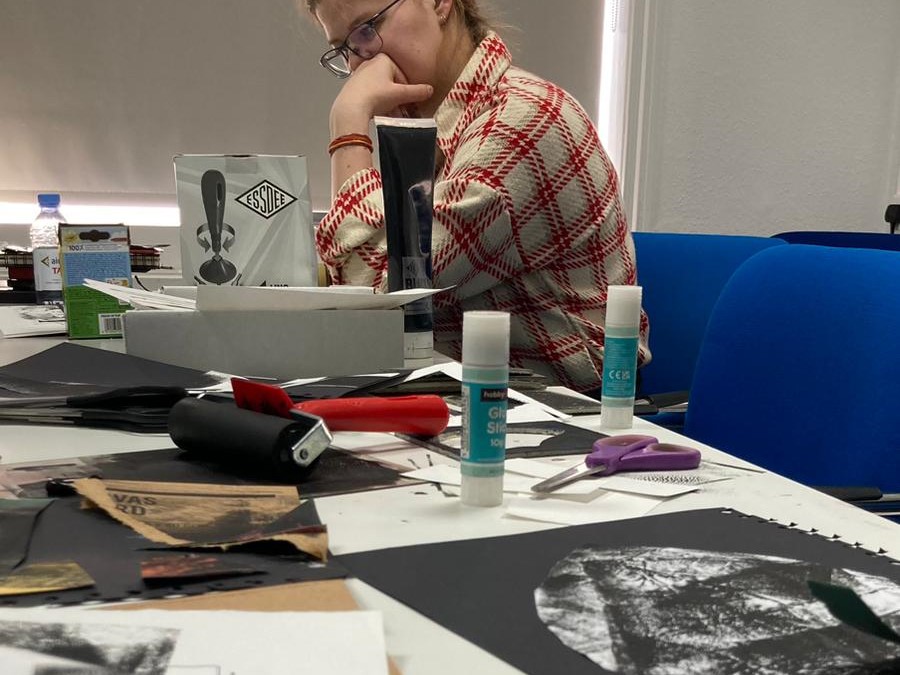
Yu-Ching: You want to include your process in your portfolio. Show your work in development, not just the final outcome. The admissions panel will want to know what your creative journey looks like, and see how you make creative decisions. These could be sketches studying the subject, rough mock-ups, or observational drawings from your sketchbook – whatever your creative process is, show that in your portfolio.
Even if you think your finished piece speaks for itself, admissions panels still require an understanding of how you got there and what your process looks like.
CSC: Should students adapt their portfolios for different universities?
Yu-Ching: Every course is different and has its own features and focus, even if they have the same title. Check the portfolio guidelines on the course website and have a look at their students’ work. It’s also important to check the guidelines for what form of portfolio they are looking for, and how they wish you to label your work throughout. Then you can refine your existing work to customise a portfolio to match each course you apply for.
CSC: Finally, what do you think makes Cambridge Seminars College a good choice for students?
Yu-Ching: CSC is great at preparing students to study at UK universities. The small sized classes enable us to identify each student’s needs and provide guidance more precisely. Especially for Art & Design subjects, every student’s interests can be very different. I am glad that we can provide individualised feedback to each student because of the environment offered by the College.
If you’re looking for a route to study art in the UK, Cambridge Seminars College is an excellent place to start. Over 95% of our graduating foundation students go on to study at their choice of 100 UK universities, and we would love to help you to do the same.
For more information, check out our Foundation Programme or contact admissions@csc.uk with further enquiries.